2027 Mercedes-Benz S-Class Facelift: What Actually Changed?
BY FALCON CAR RENTAL
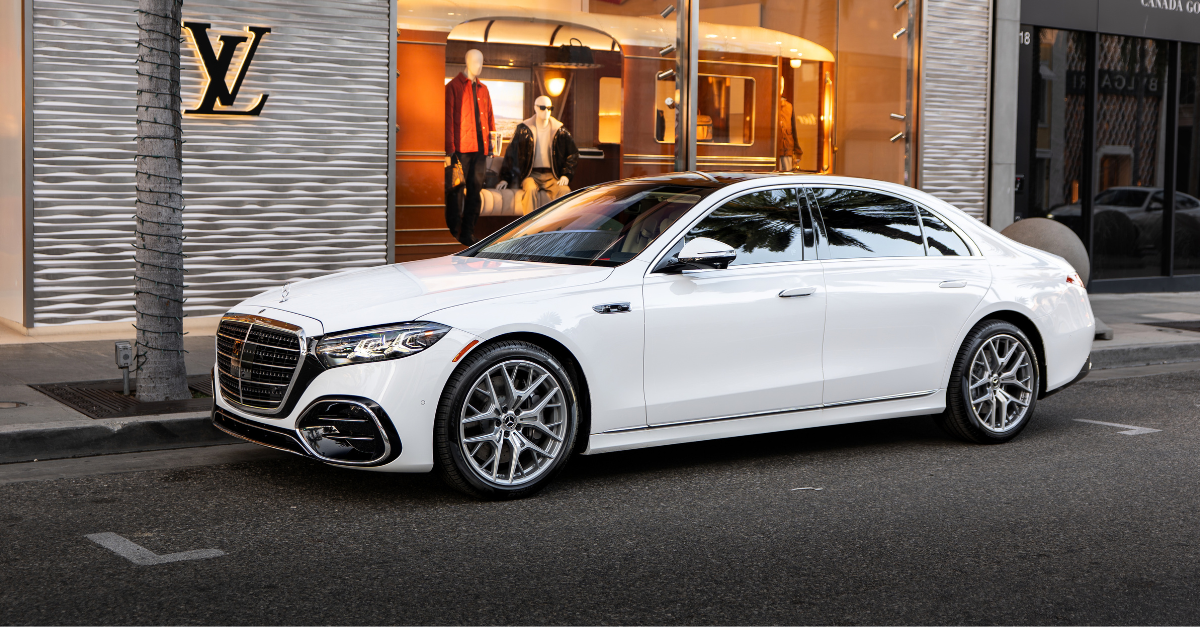
The Mercedes-Benz S-Class has never needed to reinvent itself simply to attract attention. For decades, its reputation has been built on something more difficult: introducing meaningful technology and comfort improvements while preserving the calm, understated character expected from a flagship luxury sedan. That is what makes the 2027 S-Class facelift particularly interesting. Although the overall shape remains familiar, Mercedes-Benz says more than half of the vehicle has been newly developed, updated, or refined, making this far more substantial than a typical mid-cycle refresh.
The changes extend well beyond new headlights and a revised grille. The 2027 S-Class receives a new digital architecture, an updated MBUX experience, stronger rear-seat technology, revised six- and eight-cylinder engines, smarter suspension systems, expanded personalization, and a more distinctive exterior identity. Rather than changing what the S-Class fundamentally is, Mercedes has focused on making the experience more intelligent, more refined, and more relevant to the way luxury clients travel today.
A More Distinctive Exterior Without Losing the S-Class Identity
The most visible changes begin at the front, where Mercedes has given the S-Class a stronger presence without abandoning the proportions that have defined the model for generations. The grille is approximately 20 percent larger than before and is now illuminated as standard, while an available illuminated standing Mercedes star gives the car an unmistakable nighttime signature. The new DIGITAL LIGHT headlamps incorporate star-inspired lighting elements, and similar graphics appear in the redesigned rear lamps.
The result is noticeably more expressive than the outgoing model, but the S-Class still avoids the aggressive styling increasingly common among performance-oriented luxury cars. Its long hood, formal roofline, and restrained surfaces continue to communicate executive luxury rather than sportiness. The refreshed details simply make the car easier to recognize, particularly after dark.
That added presence feels appropriate for a sedan often used for formal arrivals, business travel, and chauffeur-driven transportation. Clients arranging a luxury chauffeur service in Beverly Hills are usually looking for a vehicle that conveys importance without becoming theatrical, and the updated S-Class remains well suited to that role.
The Interior Receives the More Important Transformation
Although the exterior changes will attract the most immediate attention, the larger evolution takes place inside the cabin. The 2027 S-Class introduces the MBUX Superscreen as standard equipment, replacing the previous dashboard layout with a more integrated digital environment. A 14.4-inch central infotainment display and a 12.3-inch front-passenger display sit beneath a continuous glass surface, while a separate 12.3-inch digital instrument cluster remains positioned directly in front of the driver.
The broader change is the arrival of Mercedes-Benz Operating System, or MB.OS. Rather than treating navigation, infotainment, driver assistance, and vehicle functions as largely separate systems, Mercedes is moving toward a centralized architecture designed to connect them more intelligently. The platform also supports over-the-air software updates, allowing the vehicle’s digital capabilities to evolve after delivery.
That shift matters because the S-Class has historically been used as a showcase for Mercedes-Benz technology. The 2027 model continues that tradition, but the emphasis is increasingly on integration rather than simply adding more screens or features. The goal is to make the technology feel easier to use and less demanding of the occupants’ attention.
MBUX Becomes More Conversational and More Useful
The fourth generation of MBUX introduces another meaningful improvement. The virtual assistant now incorporates generative AI capabilities designed to support more natural, multi-step conversations instead of responding only to isolated commands. The Zero Layer interface has also been refined so that frequently used functions and recent applications can appear more intelligently without requiring the driver to navigate through several menus.
Navigation incorporates Google technology, while MBUX Surround Navigation can provide a more detailed visual representation of the car’s surroundings and driving environment. These changes may sound incremental individually, but together they move the S-Class toward a more intuitive digital experience.
For a luxury sedan, that distinction is important. Technology should not make the cabin feel busier. It should reduce the effort required to use the vehicle. The strongest luxury systems are often the ones that work so naturally that passengers stop thinking about the technology altogether.
Rear-Seat Technology Is Becoming More Important Than Ever
The S-Class has always been unusual because its rear cabin matters almost as much as the driver’s seat. That remains true for 2027, with Mercedes placing even greater emphasis on passengers who use the car as executive transportation rather than simply as a vehicle they drive themselves.
An available MBUX High-End Rear Seat Entertainment system introduces two 13.1-inch displays, replacing the smaller screens offered previously. Optional remote controls allow rear passengers to manage entertainment, climate settings, ambient lighting, seat functions, and sunshades without reaching toward the displays. Integrated cameras also support video conferencing through platforms such as Microsoft Teams, Zoom, and Webex.
These features turn the rear cabin into something closer to a mobile office. For executives traveling between meetings or clients spending substantial time in Los Angeles traffic, the ability to work privately and comfortably becomes more valuable than another performance feature. This is one of the reasons the S-Class continues to make sense in the luxury car rental in Los Angeles market: its appeal is not based only on prestige, but on how effectively it uses the time passengers spend inside the car.
Small Comfort Improvements Make a Noticeable Difference
Some of the most thoughtful changes are also the least dramatic. Mercedes has introduced heated front seatbelts, a feature designed to create warmth around the occupant more quickly without relying entirely on cabin temperature. Digital Vent Control can automatically adjust the direction of the front air vents based on individual climate settings, while an upgraded ENERGIZING AIR CONTROL filtration system improves cabin air quality by helping reduce dust and other pollutants.
The center console has also been redesigned with more trim surface, illuminated cupholders, room for two smartphones to charge wirelessly side by side, and 100-watt USB-C charging capability. None of these features is likely to define the car on its own, but together they reinforce what the S-Class has always done best: identify small sources of inconvenience and quietly remove them.
That philosophy is central to flagship luxury. The best improvements are not always the ones passengers notice immediately. Often, they are the ones that make a long journey feel easier without drawing attention to themselves.
The S 580 Receives a Significantly Revised V8
The mechanical changes are more substantial than the exterior redesign might suggest. For the U.S. market, the 2027 range includes the S 500 4MATIC, S 580 4MATIC, and plug-in-hybrid S 580e 4MATIC, giving customers three distinct approaches to flagship performance.
The S 500 continues with an updated 3.0-liter inline-six supported by mild-hybrid technology and produces 442 horsepower. Mercedes quotes a 0–60 mph time of approximately 4.3 seconds, which is more than sufficient for a sedan designed around effortless long-distance travel rather than outright performance.
The S 580 receives the more technically interesting update. Its 4.0-liter twin-turbocharged V8 now produces 530 horsepower and incorporates significant revisions to the intake, exhaust, turbocharger, and valvetrain. Most notably, Mercedes has introduced a flat-plane crankshaft and revised firing order, engineering more commonly associated with high-performance sports cars than large executive sedans.
The objective is not to make the S-Class feel like an AMG model. The reduced rotating mass is intended to improve response and allow the engine to rev more freely while preserving the smoothness expected from a flagship Mercedes. With a claimed 0–60 mph time of around 3.9 seconds, the S 580 is exceptionally quick, but its performance remains focused on effortless acceleration rather than drama.
The Plug-In Hybrid Becomes the Most Powerful Regular S-Class
The S 580e adds another interesting dimension to the lineup because it produces more total power than the conventional V8 model. Its six-cylinder engine and electric motor combine for 576 horsepower, making it the most powerful regular S-Class in the U.S. range outside the AMG and Maybach variants.
The plug-in hybrid uses a 21.96 kWh battery and is capable of electric operation for shorter journeys, while the combustion engine remains available for longer-distance travel. Mercedes quotes 0–60 mph in approximately 4.4 seconds, making the S 580e both powerful and flexible without requiring the owner to commit entirely to an electric powertrain.
This variety reflects the broader direction of the luxury market. Some clients still prefer the character and refinement of a V8, others value the efficiency and flexibility of a plug-in hybrid, while some simply want the most straightforward version of the S-Class experience. Mercedes has chosen to offer multiple answers rather than force every client toward the same type of drivetrain.
The Suspension Becomes Smarter, Not Sportier
Ride quality has always been one of the defining qualities of an S-Class, so Mercedes has focused heavily on refining the suspension rather than making the car unnecessarily aggressive. AIRMATIC air suspension with adaptive damping remains standard, and rear-axle steering is available to make the large sedan significantly easier to maneuver in parking structures, hotel entrances, and dense urban areas.
The standard rear-steering system can turn the rear wheels by up to 4.5 degrees, while a 10-degree system is available as an additional feature. On a car more than 17 feet long, that makes a meaningful difference to the turning circle and everyday usability.
E-ACTIVE BODY CONTROL remains available on certain configurations and adds more sophisticated control of individual wheel movement. For 2027, the damping systems have also become more intelligent, helping the suspension prepare for changing road surfaces and further isolate passengers from imperfections.
The S-Class has never needed to disguise its size by pretending to be a sports sedan. Its strength lies in making that size feel calm, controlled, and surprisingly easy to manage.
Driver Assistance Moves Into a More Powerful Digital Architecture
Mercedes is also reorganizing its driver-assistance technology under the MB.DRIVE umbrella. The new electrical architecture provides greater computing power and improved integration between cameras, radar, sensors, navigation information, and vehicle systems.
Current MB.DRIVE ASSIST features support functions such as adaptive cruise control, steering assistance, lane support, and parking technology. More advanced MB.DRIVE ASSIST PRO functions are planned as software and regulatory approvals develop across different markets.
The important distinction is that these remain driver-assistance technologies. The driver continues to be responsible for the vehicle and must remain attentive. Mercedes is increasing the sophistication of automation gradually rather than presenting the S-Class as fully autonomous before the technology and regulations support that reality.
For a vehicle commonly used on long highway journeys and in heavy metropolitan traffic, improvements that reduce driver fatigue without creating false confidence are arguably more useful than headline-grabbing autonomous claims.
Personalization Moves Closer to the Bespoke Luxury World
Mercedes has also expanded its MANUFAKTUR personalization program significantly. The new Made to Measure offering gives buyers access to more than 150 exterior colors and over 400 interior color possibilities, along with expanded leather, stitching, trim, wheel, and accent combinations.
That level of choice moves the S-Class closer to a world traditionally dominated by Bentley, Rolls-Royce, and other ultra-luxury manufacturers where personalization has long been a major part of the ownership experience.
For the S-Class, this feels like a natural evolution. Buyers at this level increasingly expect more than simply selecting black, silver, or white paint with one of a handful of leather interiors. They want the ability to create something that feels individual while retaining the quality and consistency of a Mercedes-Benz factory product.
What Has Not Changed Is Just as Important
For all the new technology, Mercedes has resisted the temptation to fundamentally change what the S-Class represents. The proportions remain formal and familiar, the cabin continues to prioritize comfort over spectacle, rear passengers still receive unusual attention, and the suspension remains focused on making imperfect roads feel less intrusive.
That continuity is important because the S-Class has one of the strongest identities in the luxury sedan market. Mercedes did not need to turn it into a completely different kind of car. It needed to make it more intelligent and contemporary without losing the qualities that allowed the model to remain relevant for generations.
The result is a sedan that feels more modern without becoming trend-driven.
What the 2027 S-Class Means for Luxury Travel
The updated S-Class is particularly well suited to travelers who value the time spent inside the vehicle as much as the destination itself. For an executive, rear-seat connectivity and video conferencing may matter more than acceleration. For a couple arriving for dinner in Beverly Hills, the quiet ride and new nighttime lighting signature may define the experience. For a client who wants to rent a Mercedes with delivery service in Los Angeles, convenience, luggage space, vehicle presentation, and a smooth handoff may matter more than the technical details of the revised V8.
That breadth is part of the reason the S-Class has endured. It can appeal to someone fascinated by engineering and technology while remaining equally attractive to a passenger who simply wants to arrive comfortably, privately, and without unnecessary complication.
The best flagship sedans manage both.
Final Thoughts: More Than a Typical Facelift
Calling the 2027 Mercedes-Benz S-Class a facelift does not fully capture the scale of the changes.
The larger grille, illuminated details, and new lighting provide the obvious visual differences, but the more meaningful improvements sit beneath the surface. MB.OS changes the digital foundation of the vehicle. The standard Superscreen transforms the dashboard. The upgraded rear entertainment system makes the cabin more useful for executive travel. The revised V8 introduces genuinely interesting engineering, while smarter suspension technology further develops the ride quality that has always defined the S-Class.
Mercedes-Benz says more than half of the vehicle has been newly developed, updated, or refined, and the breadth of the changes supports that description. The company has not tried to reinvent the S-Class simply for the sake of making the facelift appear more dramatic. Instead, it has focused on strengthening the qualities that made the model important in the first place.
For 2027, the S-Class remains what it has always tried to be: a luxury sedan designed not simply to showcase technology, but to make sophisticated technology feel effortless.