Ferrari Purosangue vs Lamborghini Urus SE: Two Ways to Experience Italian Performance
BY FALCON CAR RENTAL
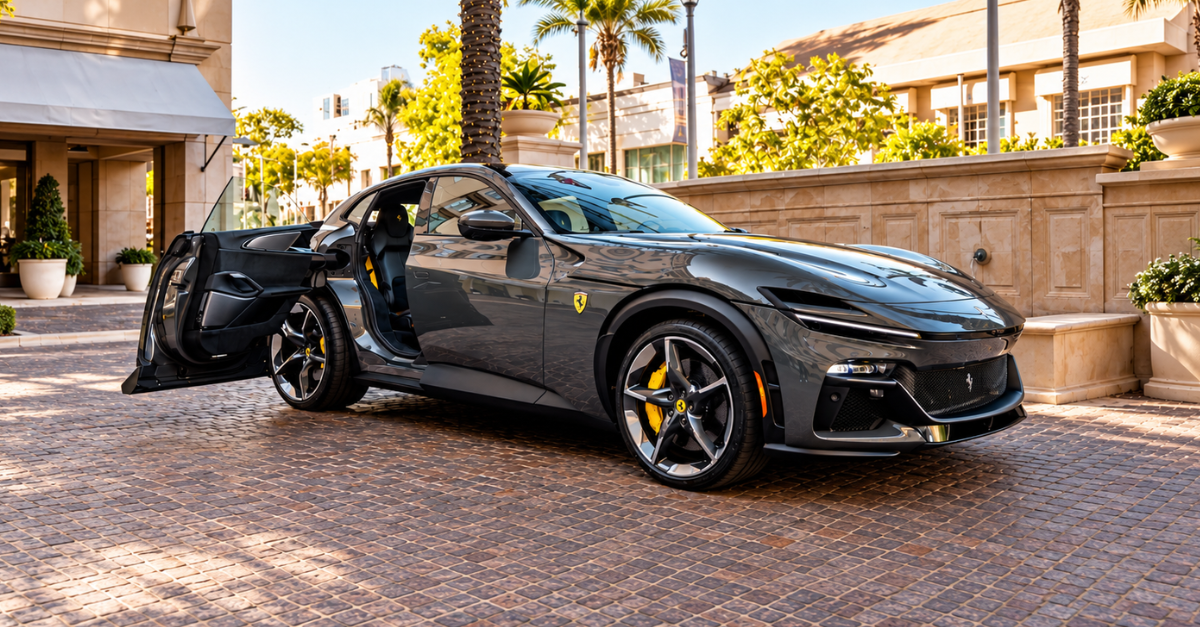
Ferrari and Lamborghini have spent decades competing for the same attention while rarely building cars that feel anything alike.
Ferrari traditionally approaches performance through balance, precision, and mechanical emotion. Lamborghini has always leaned harder into theater: sharper design, stronger visual presence, and the sense that even an ordinary arrival should feel like an event.
The Ferrari Purosangue and Lamborghini Urus SE carry those philosophies into the luxury performance SUV world.
Both offer four doors, extraordinary speed, genuine passenger space, and enough practicality to work in everyday life. But beneath those similarities, they represent almost opposite ideas of where high-performance luxury is heading.
The Purosangue is deliberately traditional where it matters most. Ferrari gave it a naturally aspirated 6.5-liter V12 with no hybrid assistance, preserving a kind of engine experience that is becoming increasingly rare.
The Urus SE looks forward instead. Its twin-turbocharged V8 works with a plug-in hybrid system to deliver more total power, meaningful electric-only driving, and a broader range of personalities than any previous Urus.
One protects the emotional qualities of the past.
The other embraces the technology shaping the future.
That is what makes this rivalry far more interesting than a simple horsepower comparison.
Ferrari Purosangue: A Ferrari Before Anything Else
Ferrari has always been careful about calling the Purosangue an SUV.
The company describes it as its first four-door, four-seat production car, and that distinction helps explain the vehicle better than the SUV label alone ever could.
The Purosangue does not feel like Ferrari took a conventional luxury SUV and added more performance. Its proportions, seating position, powertrain, and chassis philosophy feel closer to an elevated grand tourer that happens to offer four doors, useful luggage space, and greater everyday versatility.
At the center of everything is Ferrari’s 6.5-liter naturally aspirated V12, producing 725 CV. Ferrari quotes 0–100 km/h in 3.3 seconds and a top speed above 310 km/h.
Those numbers are serious.
But they are almost secondary to the way the engine delivers them.
The V12 builds power progressively, becoming more intense as the revs rise. There is no turbocharger flattening the character of the power delivery and no electric motor filling the gaps. The engine asks to be revved, listened to, and experienced.
That is increasingly unusual.
Ferrari could easily have hybridized the Purosangue. Instead, it gave the car one of the purest engines still available in any modern luxury vehicle.
That decision may end up being one of the reasons the Purosangue becomes so memorable.
Lamborghini Urus SE: A Super SUV Built for the Next Era
Lamborghini made the opposite choice.
The Urus SE is the first plug-in hybrid version of the brand’s Super SUV, combining a 4.0-liter twin-turbocharged V8 with an electric motor for a total output of 800 CV and 950 Nm of torque.
Lamborghini claims 0–100 km/h in 3.4 seconds and a top speed of 312 km/h. Its 25.9 kWh battery also provides more than 60 kilometers of official electric range under WLTP testing.
That gives the Urus SE something the Ferrari simply does not have: two genuinely different personalities.
In electric mode, it can move quietly through residential streets, hotel entrances, or city traffic without waking the V8. Then, once the full powertrain comes alive, the experience changes completely. The electric motor adds immediate torque, the V8 brings the drama, and the result feels far more aggressive than the quiet start suggests.
That contrast is part of the appeal.
The Urus SE does not use electrification to become more responsible at the expense of excitement.
It uses electrification to become more versatile and more powerful at the same time.
Naturally Aspirated V12 vs Plug-In Hybrid V8
This is the heart of the comparison.
The Purosangue feels special because of what Ferrari refused to give up.
The Urus SE feels advanced because of what Lamborghini added.
Ferrari surrounds its V12 with sophisticated technology including active suspension, four-wheel steering, and its 4RM-S evo all-wheel-drive system. But the technology works quietly in the background. The engine remains the emotional center of the experience.
Lamborghini places electrification much closer to the foreground. The Urus SE uses its electric motor, electronically controlled center differential, and active torque distribution to broaden both performance and usability.
The philosophical difference is clear.
The Ferrari is built around mechanical character.
The Lamborghini is built around technological range.
Neither approach is outdated or inherently superior. They simply appeal to different types of drivers.
The Purosangue is for someone who believes experiences like a naturally aspirated Ferrari V12 may not exist forever.
The Urus SE is for someone who wants to experience what electrification can add to a modern performance SUV right now.
Which One Is Faster?
On paper, the answer is less dramatic than the horsepower figures suggest.
The Urus SE produces 800 CV, considerably more than the Purosangue’s 725 CV. Yet Ferrari claims 0–100 km/h in 3.3 seconds, compared with Lamborghini’s 3.4 seconds.
At the top end, Lamborghini claims 312 km/h, while Ferrari lists the Purosangue at more than 310 km/h.
In the real world, that difference is essentially irrelevant.
Both are outrageously fast for vehicles with four doors and meaningful luggage space.
The more important question is how they make speed feel.
The Purosangue builds toward it. The V12 becomes more expressive as the revs climb, giving acceleration a sense of progression and drama.
The Urus SE attacks more immediately. Hybrid torque gives it an instant response that makes the vehicle feel brutally effective from low speed.
Ferrari gives you anticipation.
Lamborghini gives you impact.
Design: Sculpture vs Theater
The difference is just as obvious from the outside.
The Purosangue is unusually low and fluid for a vehicle in this category. Its long hood, sculpted sides, compact greenhouse, and athletic proportions make it look closer to a tall grand tourer than a conventional SUV.
Even the rear doors are unconventional. Ferrari uses rear-hinged “welcome doors,” improving access to the back seats without disrupting the shape of the body.
The design feels cohesive rather than aggressive.
The Urus SE has no interest in that kind of restraint.
Its sharper surfaces, wider visual stance, dramatic lighting, and angular aerodynamic elements make its intentions obvious. Lamborghini revised the SE’s aerodynamics and cooling as part of the hybrid update, but visually the car remains unmistakably theatrical.
The Ferrari rewards a second look.
The Lamborghini makes sure you looked the first time.
That contrast is exactly what buyers expect from these two brands.
Inside: Four-Seat Ferrari vs Full-Sized Lamborghini Experience
The Purosangue seats four people, and only four.
Every occupant gets an individual seat, creating a cabin that feels more intimate than the typical luxury SUV. The rear passengers are treated as part of the experience rather than simply accommodated in the back.
Ferrari also gives the Purosangue 473 liters of luggage capacity, unusually practical for a Ferrari and slightly more than the Urus SE’s official 454 liters.
That is one of the more surprising facts in this comparison.
The Lamborghini looks like the more conventional SUV, but the Ferrari actually offers slightly greater quoted cargo volume.
Still, the Urus feels more familiar in everyday use. Its cabin is broader in character, more technology-driven, and closer to what people expect from a modern premium SUV. It is easier to imagine using the Urus for everything from meetings to airport runs to a weekend away.
The Purosangue never lets you forget that you are inside a Ferrari.
That is both its greatest strength and part of what makes it more specialized.
Which Is Easier to Live With?
For pure everyday usability, the Urus SE has the edge.
Its plug-in hybrid system allows quiet electric driving, its cabin feels more conventional, and its various driving modes let the vehicle adapt to city streets, highways, spirited driving, and changing road conditions.
It can behave like a sophisticated luxury SUV when asked.
Then it can become something far more aggressive almost instantly.
The Purosangue is remarkably usable by Ferrari standards. Four proper doors, genuine rear-seat comfort, usable cargo space, and an elevated driving position make it dramatically easier to live with than a traditional Ferrari sports car.
But it still feels like an event.
There is still a V12 in front of you. The driving position remains deliberately performance-oriented. The sound and responses constantly remind you that practicality was added to the Ferrari experience rather than replacing it.
The Urus SE fits around everyday life more naturally.
The Purosangue makes everyday life feel less ordinary.
Which One Makes More Sense in Los Angeles?
Los Angeles may be one of the few cities where neither vehicle seems excessive.
The Urus SE makes immediate sense here. It has enough visibility and practicality for daily traffic, enough road presence for Beverly Hills and West Hollywood, and enough performance to feel genuinely special once the city begins to open up.
For clients looking to hire a Lamborghini in Los Angeles, the Urus SE offers much of Lamborghini’s drama without the compromises of a low two-seat supercar.
The Purosangue creates a different version of Los Angeles.
It feels made for the transition from Beverly Hills toward Malibu, for an early morning canyon drive, or for a longer route where the V12 becomes part of the experience rather than simply the power source.
For someone considering a Ferrari rental in Beverly Hills, the Purosangue offers something Ferrari could never really offer before: the emotional experience of the brand without restricting the day to two people and minimal luggage.
The Urus adapts beautifully to Los Angeles.
The Purosangue makes you want to drive beyond it.
Which Works Better for a California Road Trip?
Both are unusually capable road-trip vehicles for machines with this level of performance.
The Urus SE offers the broader range of personalities. It can move quietly through urban areas, settle into long highway stretches, and still deliver enormous performance when the road gets interesting.
The Purosangue takes a more romantic approach.
Its V12, four-seat cabin, active suspension, and meaningful luggage space make it surprisingly well suited to longer California drives. Routes toward Napa, Monterey, Carmel, or the coast allow the Ferrari to demonstrate what its grand-touring character is really about.
For travelers looking to rent a luxury SUV in San Francisco, either could turn Northern California into a serious driving experience. The Urus SE offers greater technological flexibility. The Purosangue offers the more emotional journey.
That difference matters more over distance than another fraction of a second to 60 mph ever will.
Which One Feels More Exclusive?
This is where the Ferrari starts to separate itself.
The Urus has been extraordinarily successful for Lamborghini and has become a familiar sight in major luxury markets around the world. The SE is the newest and most technologically advanced version, but it remains part of a model line that has become one of Lamborghini’s most popular products.
The Purosangue feels rarer and more unusual.
Part of that comes from Ferrari’s controlled production approach. Part comes from the V12. And part comes from the fact that Ferrari waited so long to create a vehicle like it.
Seeing a Purosangue still feels like seeing something unexpected.
That sense of rarity adds another layer to the experience.
The Urus SE makes a stronger visual statement.
The Purosangue may make the more exclusive one.
Which One Should You Choose?
Choose the Ferrari Purosangue if you value naturally aspirated sound, mechanical character, rarity, elegant design, and the feeling that driving should remain the centerpiece of the experience.
Choose the Lamborghini Urus SE if you want more total power, plug-in hybrid flexibility, bolder styling, greater everyday adaptability, and a vehicle that can switch more easily between quiet luxury and outright performance.
The Purosangue feels special because it preserves something the industry is slowly leaving behind.
The Urus SE feels special because it shows where the industry is heading.
That makes the choice far more interesting than Ferrari versus Lamborghini.
It is tradition versus transformation.
The FALCON Perspective
At FALCON, clients rarely choose between Ferrari and Lamborghini based on a specification sheet.
They choose based on personality.
The Purosangue appeals to the client who wants Ferrari’s V12 character in a form that can finally accommodate passengers, luggage, and longer travel without giving up the emotion of the brand.
The Urus SE appeals to someone who wants Lamborghini presence but also needs a vehicle flexible enough to work across an entire trip.
Neither is trying to replace a traditional supercar.
They solve a different problem.
They bring much of the emotion, performance, and identity of Ferrari and Lamborghini into vehicles that ask for dramatically fewer compromises.
That may be the most important reason both are so desirable.
Final Thoughts
The Ferrari Purosangue and Lamborghini Urus SE answer the same question in completely different ways:
What should an Italian performance SUV feel like when practicality is no longer enough?
Ferrari answers with twelve naturally aspirated cylinders, four individual seats, sophisticated chassis technology, and a commitment to preserving the mechanical emotion that made the brand famous.
Lamborghini answers with 800 CV, plug-in hybrid technology, electric-only capability, advanced torque management, and a more aggressive vision of what a modern Super SUV can become.
The Purosangue feels like a Ferrari that learned how to accommodate everyday life.
The Urus SE feels like a luxury SUV that learned how to become an even more complete Lamborghini.
Both are extraordinary.
But they are extraordinary for opposite reasons.
And that is exactly why this rivalry is so compelling.