Robots vs. White Gloves: Can Autonomous Cars Ever Replace Chauffeurs?
BY FALCON CAR RENTAL
Robots vs. White Gloves: Can Autonomous Cars Ever Replace Chauffeurs?
Autonomous vehicles are changing what it means to be driven.
Not long ago, the idea of stepping into a car with no one behind the wheel still felt futuristic. Today, autonomous ride services already operate in major cities, and automakers continue developing increasingly advanced driver-assistance systems. It is easy to imagine a future where a vehicle can collect a passenger, navigate traffic, and arrive at a destination with very little human involvement.
For transportation, that is remarkable progress. Luxury travel, however, asks for something more.
A chauffeur does not simply operate the vehicle. The best chauffeurs manage timing, luggage, hotel entrances, private terminals, schedule changes, and the small details passengers should never have to think about. Autonomous cars may eventually become exceptional drivers, but replacing the chauffeur means replacing something much harder to automate: hospitality.
Autonomous Cars Have a Powerful Luxury Argument
The appeal of autonomous travel is easy to understand. A passenger can answer emails, take a private call, prepare for a meeting, or simply relax while the vehicle handles traffic and navigation.
For executives and travelers with demanding schedules, reclaiming that time has genuine value.
There is also another advantage that becomes especially interesting at the luxury level: privacy. Without a driver present, confidential conversations remain entirely between passengers. A future autonomous luxury car could remember preferred seat positions, temperature, lighting, music, destinations, and even how smoothly someone prefers to travel.
That level of personalization could be impressive, but personalization is not the same as hospitality. A system can remember that you prefer the cabin at 70 degrees. A great chauffeur can notice that it has started raining and already be waiting with an umbrella when you step outside.
That difference matters.
A Chauffeur Does Much More Than Drive
The word chauffeur is sometimes treated as a more elegant version of “driver,” but at the highest level the role is far broader.
A professional chauffeur manages the entire movement around the passenger. They know where the car should be positioned before the passenger walks outside, handle luggage, communicate with hotel staff and valets, coordinate with assistants or security when needed, and understand when conversation is welcome and when silence is preferable.
Most importantly, they adapt.
A meeting ends early. A restaurant changes. An airport pickup zone becomes congested. A passenger wants to make an unexpected stop. Someone in the group needs additional help getting into the car. None of these moments requires extraordinary driving ability, but all of them require judgment.
That is where a luxury chauffeur service in LA delivers value beyond simply avoiding the stress of driving. The best service makes the logistics of a busy day almost invisible.
Human Judgment Is the Hardest Part to Replace
Autonomous systems are becoming increasingly sophisticated at understanding roads, traffic, pedestrians, and other vehicles. Luxury hospitality requires a different kind of intelligence.
A chauffeur can recognize that a client is running late and adjust the route while coordinating with the destination. They can see that an elderly guest needs more time or notice that the group has more luggage than expected. They can understand that the person whose name appears on the reservation may not be the first person who needs assistance.
These decisions are small, but luxury service is often defined by small things done well.
The best experiences feel effortless because the person providing the service understands the situation before receiving a detailed set of instructions. That kind of contextual awareness is far more difficult to automate than braking, steering, or route selection.
The Difference Becomes Clear at the Hotel Entrance
Consider arriving at a five-star hotel.
An autonomous vehicle may eventually navigate perfectly to the entrance, stop precisely, and open the passenger door automatically. From a transportation standpoint, that is excellent.
A chauffeur can step out, greet the valet, retrieve the luggage, coordinate with the bell staff, confirm the next departure time, and make sure the vehicle is positioned appropriately for the next movement before the passenger reaches the lobby.
Those few minutes illustrate the difference between transportation and hospitality.
The same principle applies when clients hire a luxury car in Beverly Hills with delivery service. The experience begins before the engine starts. Having the right vehicle delivered to a hotel, residence, office, or agreed location removes another unnecessary step from the day.
Autonomy may eventually make vehicle delivery easier. It does not automatically replace the human service surrounding it.
Why the Escalade Still Works So Well With a Chauffeur
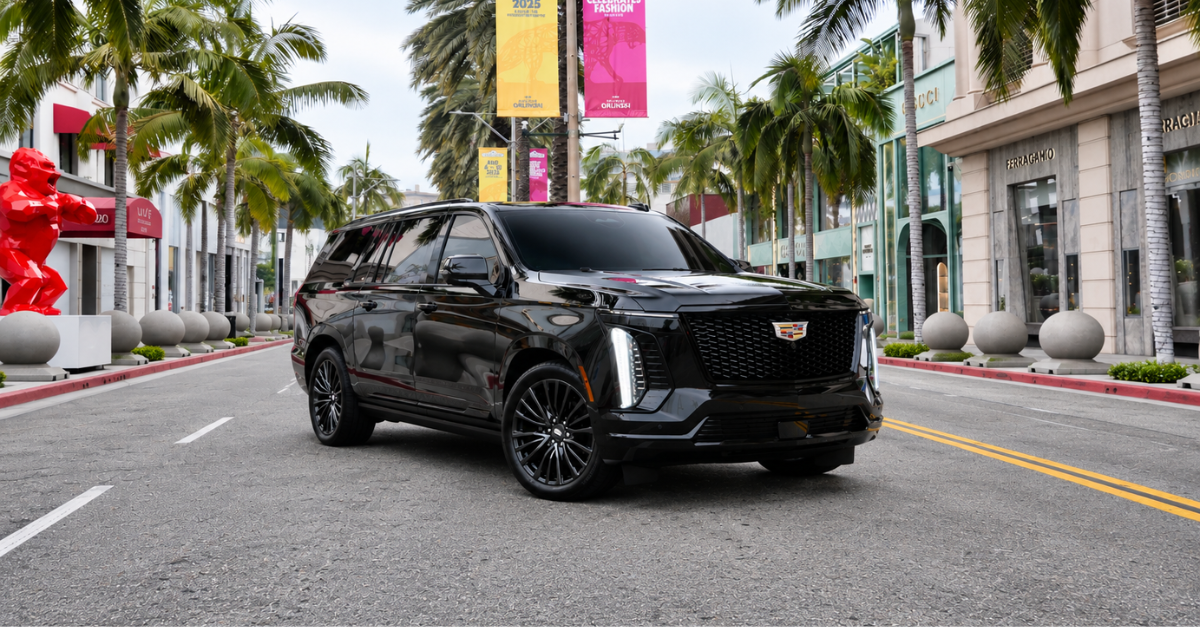
The Cadillac Escalade is a good example of why the vehicle and the chauffeur often work best as a package.
A full-size luxury SUV provides rear-seat space, luggage capacity, privacy, easy entry and exit, and enough presence to feel appropriate outside hotels, private terminals, executive meetings, and major events.
When clients rent an Escalade in Los Angeles with a driver, they are usually choosing more than a comfortable ride. The passenger can work, make calls, relax, or speak with colleagues while someone else handles parking, traffic, luggage, timing, and positioning.
An autonomous Escalade could eventually handle the driving exceptionally well. The harder question is who takes care of everything around it.
Where Autonomous Cars Could Actually Be Better
Autonomous technology has real advantages, and ignoring them would make the comparison too easy.
Machines do not become tired after a long day, impatient in traffic, or distracted. A mature autonomous system could eventually deliver extremely consistent acceleration, braking, following distance, and route discipline.
The operational benefits could be significant too. Vehicles could reposition themselves between reservations, travel for charging or servicing without a driver, and arrive at the next client already prepared.
For passengers, that consistency may become a luxury feature in itself. Someone who prefers an especially smooth, conservative ride could receive the same experience every time.
But efficiency is only one part of luxury. A perfectly optimized journey can still feel impersonal if the experience surrounding it has not been considered.
The Future Will Probably Combine Both
The most realistic future may not involve autonomous cars eliminating chauffeurs entirely.
Instead, technology could handle more of the repetitive driving while humans focus more heavily on hospitality. A vehicle might autonomously reposition between reservations or handle predictable highway sections, while a chauffeur or concierge manages passengers, luggage, scheduling, hotel coordination, and unexpected changes.
In that future, the chauffeur’s role evolves rather than disappears.
Technology handles more of the mechanics. People handle more of the context.
That combination may ultimately create a better luxury experience than either one could deliver alone.
The FALCON Perspective
At FALCON car rental, luxury mobility is ultimately about removing friction.
For one client, that may mean driving an exceptional vehicle personally. For another, it may mean having the car delivered directly to a hotel or residence. For someone with a full business schedule, the best experience may involve a professional chauffeur managing the entire journey.
Autonomous technology will make vehicles easier to position, fleets more efficient, and some journeys more private and consistent. But hospitality is still about timing, discretion, judgment, and anticipation.
Those qualities can be supported by technology. They are much harder to replace.
Final Thoughts
Autonomous cars will almost certainly become increasingly capable of replacing the act of driving. Replacing the chauffeur is a much higher standard.
A machine can know the route, monitor traffic, and deliver an extremely smooth journey. A great chauffeur understands why the passenger is running late, which entrance matters, who needs help with luggage, and when the plan needs to change.
That may be the defining line in the future of luxury mobility.
Autonomous technology can make transportation smarter and more efficient. Human service makes it feel considered.
At the highest level, the future may not be robots versus white gloves at all. It may be autonomous technology working quietly behind the scenes, with human hospitality still present wherever the client can feel the difference.