What Makes These Iconc Cars So Iconic
BY FALCON CAR RENTAL
Some cars become successful. A much smaller number becomes recognizable before you even see the badge.
That is what separates an iconic vehicle from a simply expensive one.
An icon develops a shape, character, or reputation strong enough to outlast individual model generations. It becomes associated with a particular kind of person, place, or experience. The Porsche 911 means something different from a Range Rover. A Mercedes G-Class communicates something different from a Cadillac Escalade. Yet all of them have achieved something remarkably difficult: they have become instantly identifiable without constantly reinventing themselves.
That matters in the luxury world.
Performance figures eventually get surpassed. Technology dates quickly. Trends disappear. But a strong identity can remain desirable for decades.
For travelers choosing a luxury vehicle in California, understanding that identity can also make it easier to choose the right car. Here are six vehicles in the FALCON fleet that have earned genuine icon status — and why they continue to matter.
Land Rover Defender — An Adventure Icon Reimagined
The Defender became iconic long before luxury was part of the conversation.
Its reputation was built on utility, durability, and the ability to travel where ordinary vehicles could not. For decades, the original Defender was associated with expeditions, rural estates, military use, and remote landscapes rather than polished city streets.
The modern Defender changed the formula without abandoning the identity.
It retained the upright proportions, squared-off stance, and rugged visual character that made the original recognizable, but transformed the experience inside. Today’s Defender adds modern technology, far greater comfort, and a cabin refined enough for everyday luxury travel.
That combination is why the Defender works so well now. It still suggests adventure, but no longer requires sacrificing comfort to achieve it.
For a California itinerary that includes city driving, coastal roads, mountains, or more relaxed outdoor destinations, the Defender offers a type of versatility few luxury SUVs match. It feels appropriate outside a Malibu hotel, but equally convincing on the way toward the desert or mountains.
Its appeal comes from authenticity.
The Defender did not become rugged because rugged styling became fashionable. That history came first.
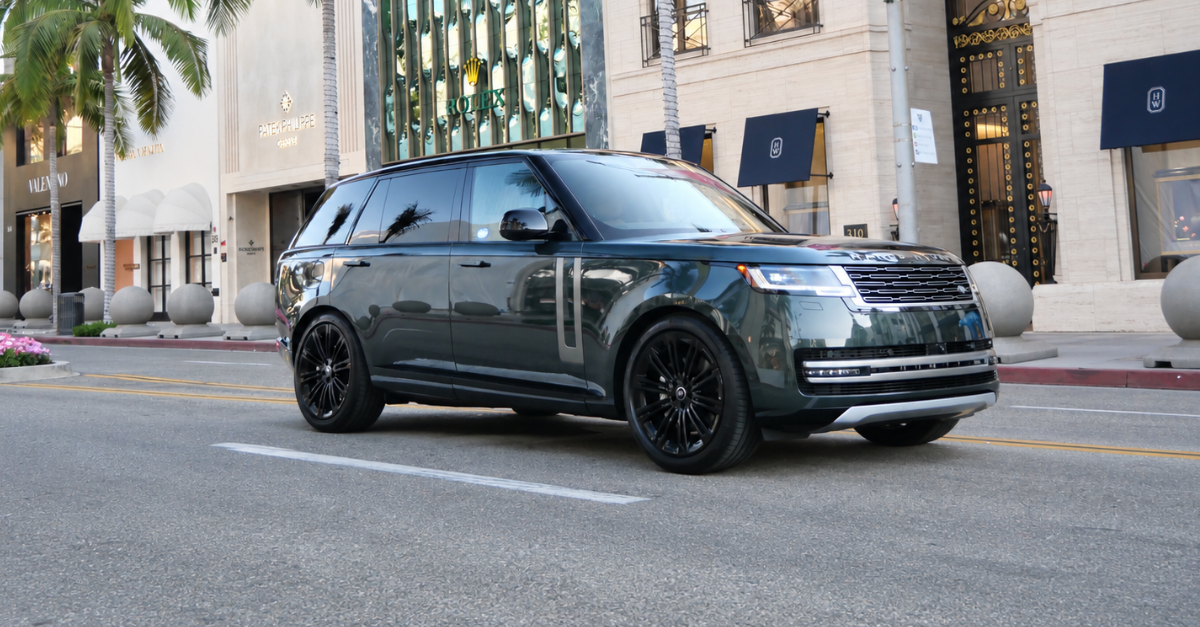
Range Rover — The Original Luxury SUV Formula
Few vehicles have influenced the modern luxury SUV more than the Range Rover.
Since the original model arrived in 1970, the concept has remained remarkably consistent: combine genuine capability with a level of refinement that makes the vehicle equally comfortable in the countryside or outside a luxury hotel.
That balance eventually became the blueprint for an entire segment.
Today, almost every premium manufacturer offers an expensive SUV. But the Range Rover still carries a particular kind of authority because it never feels like a luxury sedan that was simply made taller. Its identity was built around the SUV from the beginning.
The design is a major part of that appeal. The upright silhouette, clean surfaces, floating roof treatment, and understated proportions have evolved carefully rather than dramatically. That continuity is one reason a modern Range Rover still feels connected to earlier generations without looking nostalgic.
It also remains one of the strongest choices for longer trips. Families who hire a Range Rover for a one-way family trip can combine generous passenger comfort, luggage capacity, a commanding driving position, and long-distance refinement in one vehicle.
That is what makes the Range Rover iconic.
It does almost everything, but never looks like it is trying too hard.
Mercedes-Benz G-Class — The Shape That Refused to Change
The Mercedes G-Class might be the clearest example of an automotive design becoming stronger because it refused to follow trends.
Originally developed as a serious off-road vehicle, the G-Class retained its upright windshield, exposed hinges, flat body sides, squared proportions, and unmistakable silhouette even as the interior and performance moved steadily further into the luxury world.
That contrast became its identity.
A modern G-Class can contain premium leather, sophisticated technology, high-performance AMG engineering, and virtually every comfort expected from a luxury SUV. Yet from across the street, its basic shape remains instantly connected to decades of G-Class history.
That is extremely rare.
Most vehicles need constant redesign to feel relevant. The G-Class became more desirable by remaining recognizable.
There is also something unusually tactile about it. The heavy doors, distinctive closing sound, high seating position, and upright view through the windshield give the vehicle a physical character that many modern SUVs have lost.
It is not subtle, but it is authentic.
And authenticity is one of the hardest qualities for a luxury brand to manufacture.
BMW M4 — Modern Performance with Everyday Usability
The BMW M4 is younger than several vehicles on this list, but its roots run through decades of BMW M performance cars.
Its appeal comes from a formula BMW has repeatedly refined: take a car that can function comfortably in everyday life and give it serious performance capability without making it unusable.
That sounds straightforward. It is surprisingly difficult to execute well.
The M4 brings together powerful acceleration, rear-biased performance character, precise handling, usable seating, modern technology, and a cabin comfortable enough for longer drives. It can feel aggressive when the road opens up, then settle into ordinary Los Angeles traffic without becoming exhausting.
That versatility has become part of the BMW M identity.
The M4 is not iconic because it is the most exotic car available. It is iconic because it represents a particular kind of enthusiast: someone who still wants the drive to matter but does not want the rest of life to revolve around accommodating the car.
That is why the M4 feels so relevant in California. Canyon roads, highways, business meetings, coastal drives, and evening plans can all exist on the same day.
Few performance cars move between those worlds as naturally.
Porsche 911 — The Silhouette That Became a Language
Very few automotive designs have remained as recognizable for as long as the Porsche 911.
Its basic proportions date back to the 1960s: the rounded roofline, pronounced front fenders, compact rear, and rear-engine architecture. Every generation has evolved, sometimes dramatically beneath the surface, but Porsche has protected the visual identity with unusual discipline.
That continuity is a major reason the 911 became iconic.
It does not need to chase whatever shape happens to be fashionable because it already owns one.
But the 911’s reputation is not based on design alone. It has also spent decades proving itself as a serious performance car while remaining unusually usable. A modern 911 can handle a canyon road, a long highway drive, city traffic, or a dinner arrival without feeling fundamentally misplaced in any of them.
That combination of engineering credibility and timeless design is difficult to reproduce.
The 911 is also one of those cars where the person choosing it often cares as much about what the vehicle is as what it can do. There is history behind the shape. There is motorsport credibility behind the badge. And there is a consistency to the driving philosophy that gives the car meaning beyond its current horsepower figure.
That is why the 911 rarely needs an introduction.
Cadillac Escalade — The SUV That Became Part of American Luxury Culture
The Cadillac Escalade became iconic for a completely different reason.
It did not create the luxury SUV category, but it helped define what the large American luxury SUV would become.
The formula was unapologetic from the beginning: generous space, commanding dimensions, comfort, road presence, and unmistakably American scale. Over time, the Escalade became associated with entertainment, professional sports, executive transportation, nightlife, and high-profile arrivals.
It became cultural, not just automotive.
That is especially visible in Southern California. An Escalade rental in Orange County works because the vehicle combines real practicality with the kind of presence expected in a premium environment. Families can use the third row and cargo space. Executives can travel comfortably. Groups can move together without needing multiple cars.
The modern Escalade has also become far more sophisticated inside, with large digital displays, premium materials, advanced driver technology, and a cabin designed to make long drives genuinely comfortable.
Its icon status comes from that combination of practicality and presence.
Few vehicles that are useful also feel this recognizable.
Why These Cars Continue to Matter
These six vehicles became icons for very different reasons.
The Defender represents authentic adventure.
The Range Rover turned capability into quiet luxury.
The G-Class transformed utilitarian design into a status symbol without losing its original shape.
The BMW M4 represents the modern performance car that still works in everyday life.
The Porsche 911 shows what happens when a manufacturer protects a great idea for generations.
The Cadillac Escalade turned size, comfort, and American confidence into a cultural identity.
None of them became iconic simply by being expensive.
They became iconic because they became recognizable expressions of something larger.
Choosing the Right Icon for Your Trip
That history is interesting, but for a renter the more practical question is: which one fits the trip?
For families or groups, the Range Rover and Escalade are usually the easiest choices. Travelers who rent a luxury SUV at LAX often need real luggage capacity, comfortable seating, and enough versatility to handle everything from airport traffic to longer California drives. Both deliver that, but with very different personalities: the Range Rover is more understated, while the Escalade offers greater scale and a stronger American presence.
The Defender suits travelers who want something more relaxed and adventurous. The G-Class is for someone who wants a stronger visual statement while retaining SUV practicality.
The M4 makes sense for a driver who prioritizes performance but still needs genuine everyday usability.
And the Porsche 911 is the enthusiast choice — the car for someone who wants the road itself to become part of the trip.
There is no single best option.
The right one depends on what kind of experience you want the vehicle to create.
The FALCON Perspective
At FALCON, iconic vehicles matter because clients rarely choose cars based on specifications alone.
They choose the Range Rover because they know what it represents. They choose the G-Class because the shape has meaning. They choose the 911 because decades of engineering and design have made it something far more significant than another sports car.
That emotional recognition is difficult to reproduce.
Our role is to pair that character with the right journey, whether it is an airport arrival, a family road trip, a business stay, a coastal weekend, or simply the opportunity to experience a car someone has admired for years.
The vehicle should fit the occasion.
And the service around it should make experiencing that vehicle effortless.
Final Thoughts
Cars become icons when they stop depending on the latest trend to stay desirable.
Technology will continue changing. Performance will continue increasing. New vehicles will arrive with faster acceleration, larger screens, and more advanced systems.
But genuine automotive icons survive those cycles because they stand for something recognizable.
The Defender means adventure. The Range Rover means quiet confidence. The G-Class means unmistakable presence. The M4 means usable performance. The 911 means engineering continuity. The Escalade means large-scale American luxury.
That identity is what keeps people wanting them generation after generation.
Because the cars we remember most are rarely remembered for one specification.
They are remembered because we knew exactly what they were the moment we saw them.